What is established
Driving a plate at a resonance can excite a standing-wave mode. Sand collects near its nodes. Different modes can produce different patterns. UCSB demonstration ↗
 Elsewhere Lab
Field note 002 · Sound & vibration
A little sand. A vibrating plate. Change the tone to make Chladni patterns—but what decides where each grain ends up?
Try the experiment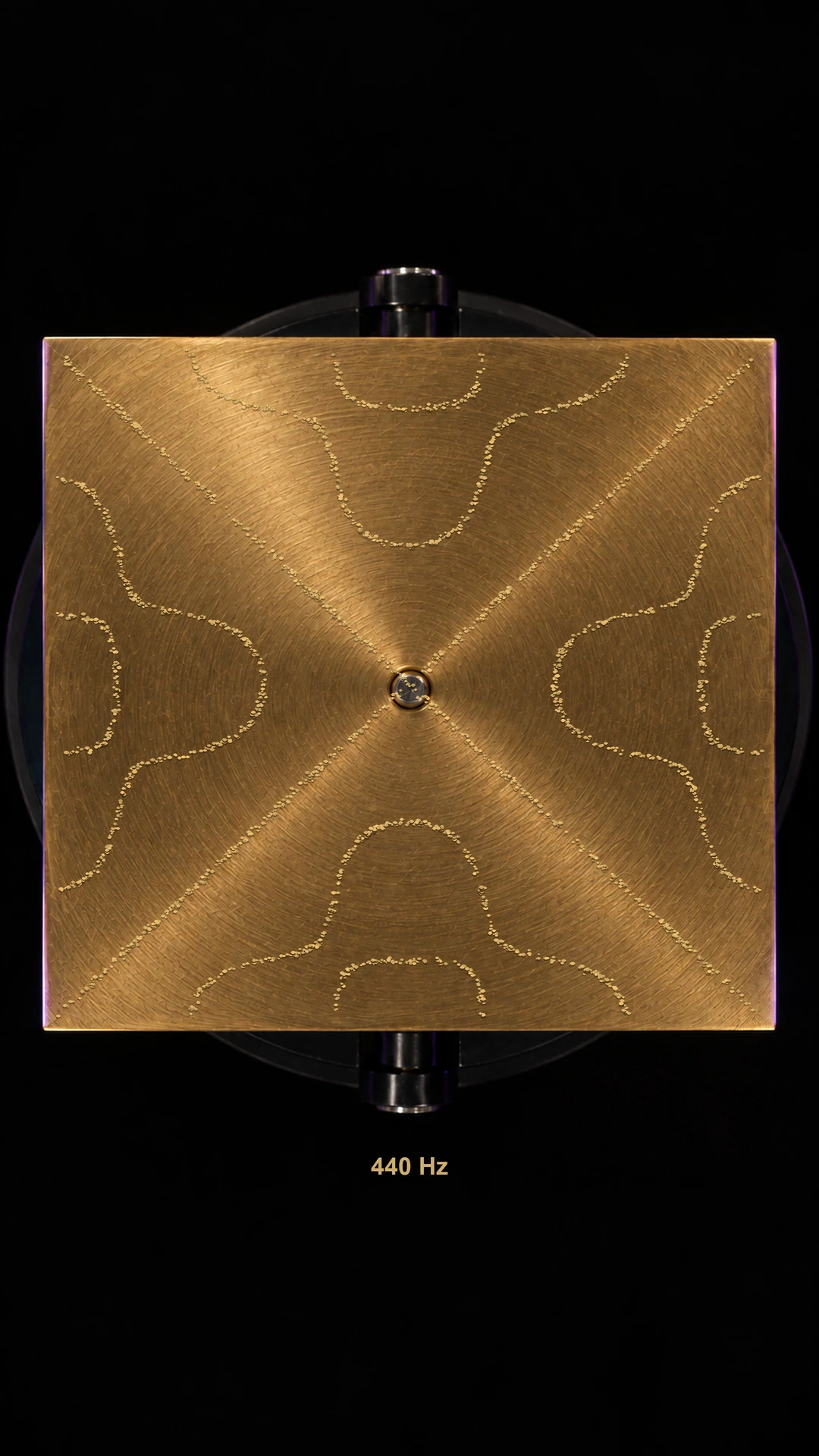
01 · Make a prediction
Choose, then start the plate. Or jump straight into the experiment.
Your experiment
Set the plate vibrating and watch the grains—not just the finished shape.
Your prediction will be revealed here after the pattern forms.
Audio is optional. Start at low volume; 760 Hz is the higher tone.
Illustrative modes, grain motion and timing. Tone labels match our short, not measured resonances of this pictured plate. What this model simplifies ↓
03 · Look beneath the pattern
A driven plate can form a standing-wave pattern. Regions flex up and down, while the nodal lines between them have little or no motion. Bouncing sand leaves the moving regions and gathers along these still lines.
Source: UCSB Physics · Chladni plates ↗The plate flexes between nodes. Sand gathers where the motion is smallest.
Illustrative slice, not an exact cross-section of either pattern above. Motion and grain migration are exaggerated.04 · Take away
These are Chladni patterns: visible traces of a vibrating plate’s nodal lines—not a picture of sound travelling through the air.
Source: Smithsonian · Chladni’s plates ↗Scientific care
Driving a plate at a resonance can excite a standing-wave mode. Sand collects near its nodes. Different modes can produce different patterns. UCSB demonstration ↗
We use two idealised mathematical patterns and guided grain motion, not a calibrated brass-plate simulation. Real resonances depend on dimensions, material and mounting. The 440/760 Hz labels identify this short’s demonstrations, not universal shapes for those frequencies.
Violet traces mark model nodes. Amber shading marks regions with larger vibration amplitude; it is not heat. Visible motion is slowed dramatically. Optional audio is a synthetic tone, not a recording of this plate.
Prepared and source-checked 12 September 2026 · Report a correction by email ↗
Explore next · Light & perception
You’ve uncovered how sound makes shapes. Now investigate why a straw looks bent in water.
Explore the refraction experiment