Follow the solid lines.
They run from the actual tip, through the surface, toward the eye. The arrows show light travelling toward you, not leaving your eye.
 Elsewhere Lab
Field note 003 · Light & perception
Why does a straw look bent in water? Change where you look from, then investigate what reaches your eye.
Investigate the illusion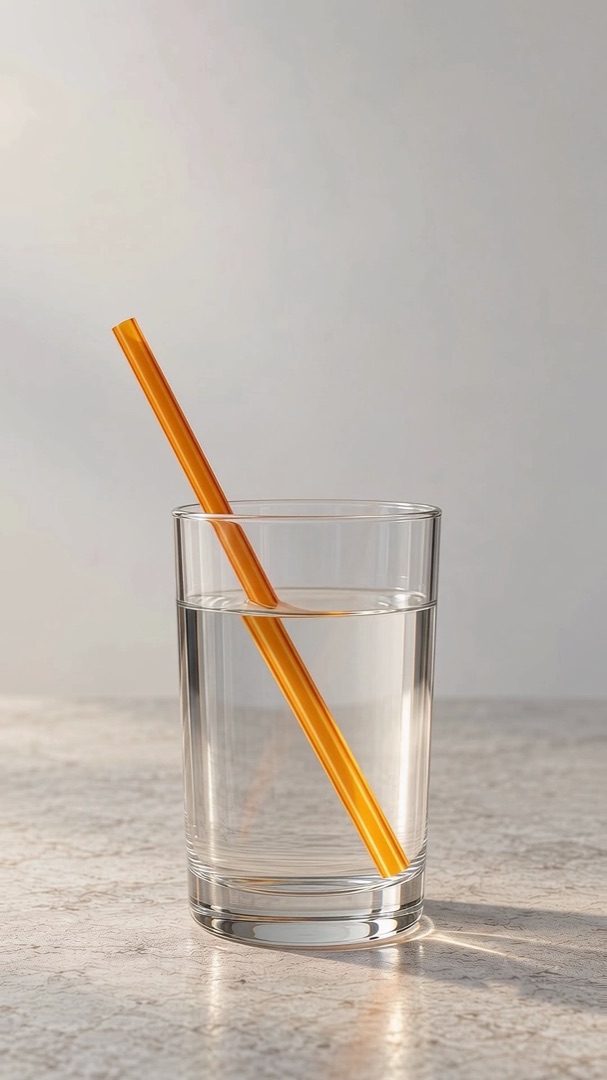
01 · Predict
Make a prediction, then reveal the light path.
Look closer
Move the eye using the slider. What happens to the submerged part of the straw?
Your prediction will appear here when you reveal the light path.
Source: AMNH · Refraction ↗Flat water–air surface · 2D ray model · Not a view through curved glass. Any moving light marker uses illustrative timing. Model limits ↓
Use the slider or drag the eye. On a keyboard, focus the slider and use ← / →. Reveal adds the actual straw and the ray construction.
03 · Follow the evidence
Light from the submerged straw changes direction at the water–air boundary. Leaving water at an angle, it bends away from the normal—the imaginary line perpendicular to the surface.
Source: OpenStax · Snell’s law ↗They run from the actual tip, through the surface, toward the eye. The arrows show light travelling toward you, not leaving your eye.
These straight extensions locate an apparent tip nearer the surface. They are a geometric construction, not another path travelled by light.
Source: OpenStax · Apparent depth ↗The violet straw stays fixed. Only the selected ray paths and the apparent straw change with the viewpoint.
04 · Take away
The straw stays straight. Refraction makes the submerged part appear somewhere else.
Scientific care
Every solid ray follows Snell’s law at a flat surface, using refractive indices 1.333 for water and 1 for air. These approximate values ignore wavelength and temperature differences. Refraction reference ↗
For each submerged point, two nearby rays enter a small model eye. Their straight backward extensions intersect at the drawn apparent point. This is a local, two-dimensional ray-bundle construction, not a complete model of human depth perception.
The short shows a round glass. This diagram isolates its flat water–air surface: curved glass walls, reflections, dispersion and binocular vision are omitted. Distances are illustrative; the optional light marker is enormously slowed.
Prepared and source-checked 12 September 2026 · Report a correction by email ↗
Explore next · Ice & pattern
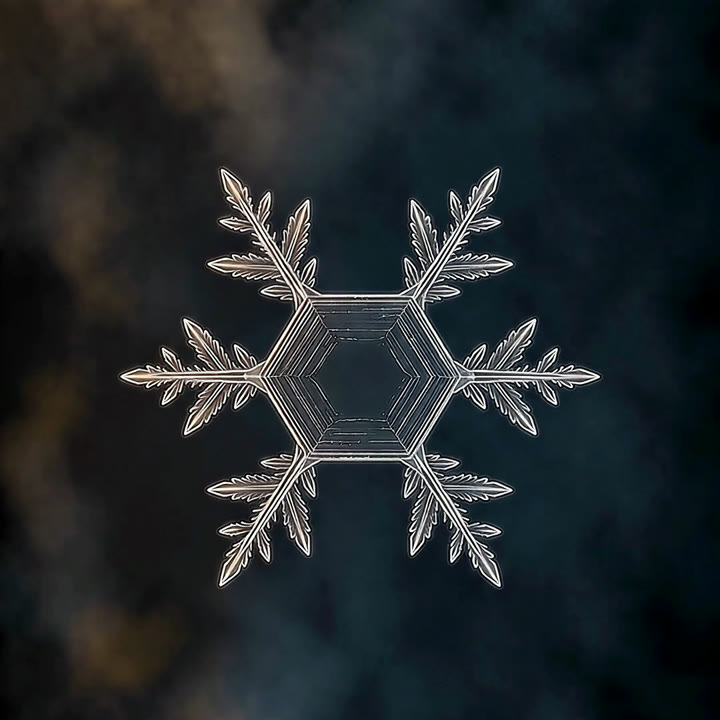
You’ve followed light through water. Now look inside ice and discover how a snow crystal grows.
Explore a growing snowflake