Choose an idea. Then grow the crystal and test it.
Two H₂O moleculesStage 1 of 6
Solid: O–H bonds inside each molecule · Dashed: hydrogen bond
Water molecules connect.
Each H₂O molecule keeps its two solid O–H bonds. A weaker hydrogen bond reaches from the partly positive hydrogen of one molecule toward the partly negative oxygen of another.
One plate-like crystal, not every kind of snowflake. Growth, scale changes and vapour levels are illustrative. What this simplifies ↓
Use ← / → inside the player to change its six stages, or drag the growth slider. Reduced motion replaces playback with still stages.
03 · Look closer
The structure sets the symmetry. The air shapes the details.
Not six neighbours.
Inside ordinary ice Ih, a water molecule has four nearest molecular neighbours. Six-membered rings occur within the larger, three-dimensional network. The sixfold symmetry is a property of that lattice—not six molecules surrounding every molecule.
Water molecules attach less readily to smooth faces than to rough spots. As a crystal grows, those slower-growing faces remain as facets. The plate is made of many repeating cells, not one enormous molecular ring.
Projecting tips gain access to vapour and can develop branches. Temperature and water-vapour supply influence the details. Nearby arms experience similar conditions; they do not communicate to match their shapes.
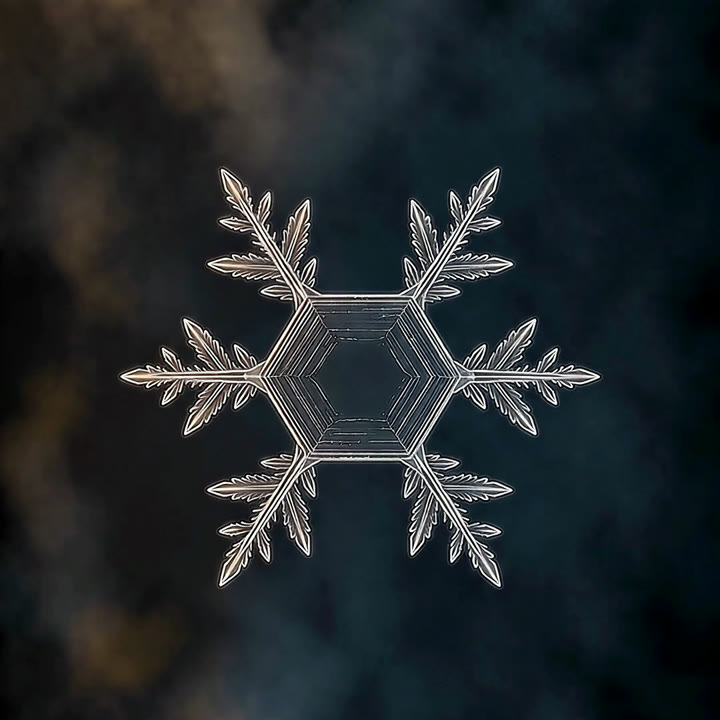
Ice’s hexagonal lattice underlies sixfold symmetry. A crystal’s journey through the air shapes its branching pattern.
Scientific care
A window into the mechanism.
Bonding, then geometry
The opening shows explicit H₂O molecules and distinguishes solid internal O–H bonds from the dashed intermolecular hydrogen bond. The expanded ideal ice-Ih view then uses molecular centres and network connections; proton orientations are omitted. Tilting reveals its depth. The scale transition is illustrative.
A growth illustration
We progressively draw connected, faceted arms—not solve heat flow, diffusion or attachment kinetics. The vapour choices are qualitative examples, not measured humidity settings. No physical duration or crystal size is implied.
Nature is less tidy
Our arms have small differences, but remain deliberately orderly. Real snow includes plates, columns, irregular crystals and aggregates; the familiar star is only one form. More on snow-crystal diversity ↗